
Door module carrier
A 679 mm panel and the bow it cannot avoid. The largest part in the series: an asymmetric door carrier with a speaker seat, service windows and a regulator opening, solved for filling, packing and out-of-plane movement.
- Application
- Automotive interior structure
- Material
- PP with 20 percent mineral filler (SABIC PPCompound PHC25/20)
- Method
- 3D Fill + Pack + Warp
- Focus
- Panel bow and thick speaker-seat junctions
- Project type
- Internal demonstration
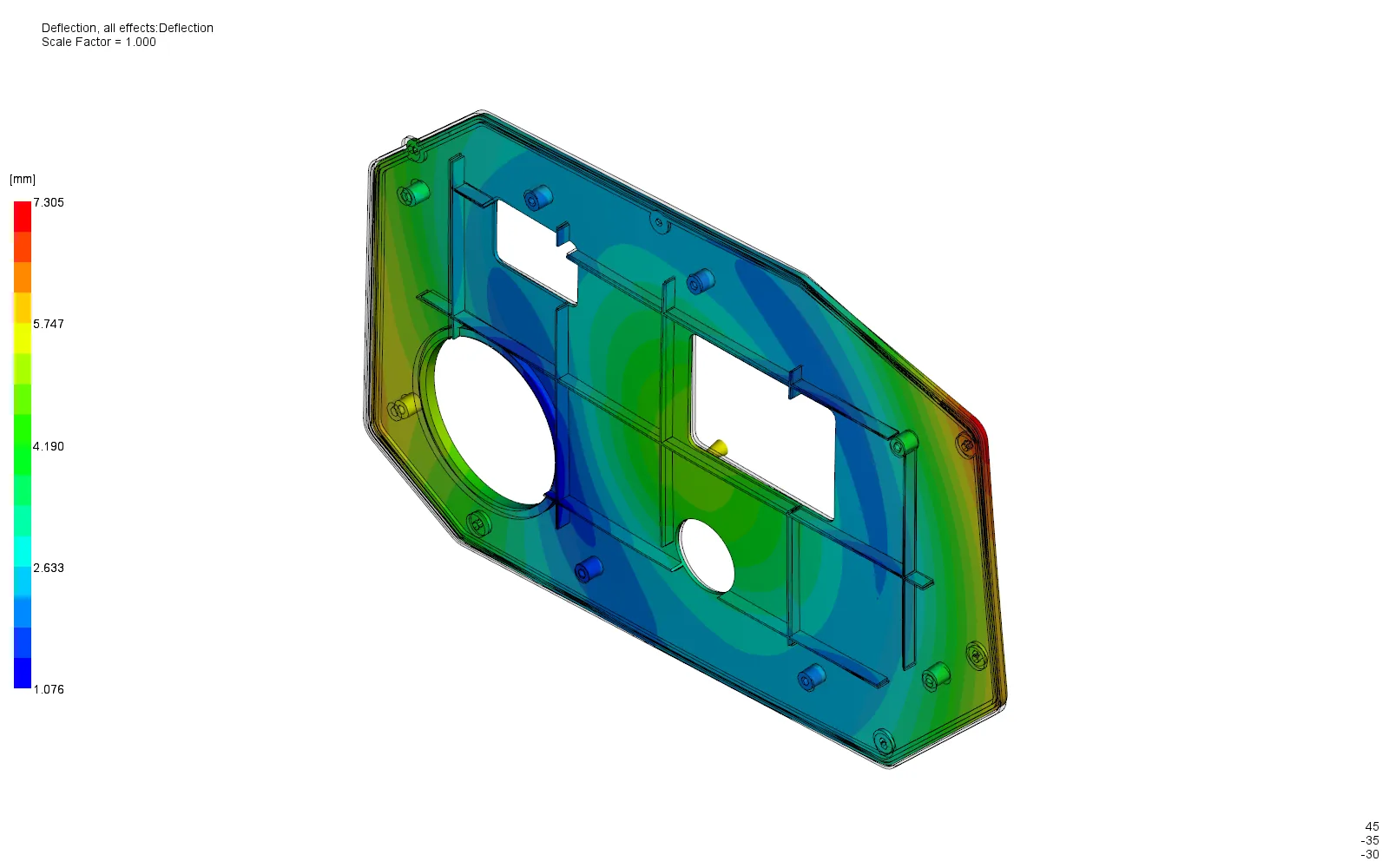
How much does a large, thin, asymmetric panel move, and where does the movement come from?
A door module carrier is a wide, shallow panel with heavy local features hung off it. That combination is exactly the one that produces bow, and the bow is what decides whether the door module closes onto its seals.
The study screens one inlet against two, then runs the 3D sequence so that panel movement can be separated into total magnitude, out-of-plane component and residual against a fitted plane.
679.0 x 429.7 x 18.0 mm, 3 mm nominal wall, 759.467 cm3: 44 features including a speaker seat, service windows, a regulator opening, ribs, cored bosses and peripheral seal lands.
A traceable engineering model.
Two-stage meshing: a Dual Domain surface first, then a 3D tetrahedral mesh generated from the corrected surface, so the screened inlet node survives into the 3D run. Gate position was screened on matched Dual Domain models, one inlet against two, before the 3D run was launched.
The 3D Fill + Pack + Warp run was solved with a single point inlet, a nominal one-second fill, switchover at 99 percent of part volume and a hold at 80 percent of filling pressure. Every plot keeps its original legend so each result can be read in its own units.
Read the result in context.
The panel fills in 1.086 s with the upper perimeter last and a V/P pressure of 64.19 MPa. The machine envelope is not established here: the feed system losses that a real tool adds are excluded from that number.
Volumetric shrinkage reaches 20.52 percent inside the speaker seat and the interior there needs 190.35 s to reach ejection temperature. That single junction dominates both the shrinkage and the cycle discussion.
Total deflection reaches 7.305 mm and the out-of-plane range is 11.307 mm across the panel. This is broad panel bow, not a local defect, and the 7.329 mm fitted-plane residual on the seal lands is the figure that matters for closure.
From evidence to action.
Treat the speaker-seat thermal junction and the sink on the face opposite the upper boss as two different mechanisms with two different fixes.
Define the sealing and mounting datums, refine the narrow lands, and correlate a revised warp result against molded parts before any tooling decision.
Study boundaries
- Internal demonstration on an original design; no customer project or physical trial correlation is claimed.
- These are simulation outputs, not measured production performance.
- Original teaching geometry; no OEM requirement set and no supplier service qualification.
- Ideal point inlet: physical gate, runner, sprue and nozzle losses are excluded.
- Uniform mold temperature; cooling circuits and mold blocks are not modeled.
- Warp uses a two-layer aggregated mesh (solver warning 201412); mesh sensitivity at thick junctions remains open.
- No dimensional, cosmetic or sealing pass/fail claim is made without defined functional requirements.
A similar question about your part?
Send the part, the material and the question.